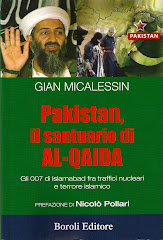
IL BLOG DEL LIBRO DI GIAN MICALESSIN PUBBLICATO DA BOROLI EDITORE
Un avvincente viaggio nei complotti dei servizi segreti pakistani che negli anni 80 aiutano la resistenza anti-sovietica in Afghanistan per conto della Cia alimentando, al tempo stesso la nascita di un’internazionale islamica ferocemente antioccidentale. Il racconto di come spie, generali e scienziati di Islamabad rubano il nucleare all’Occidente, costruiscono la prima atomica islamica e ne rivendono i segreti a Iran, Libia e Corea del Nord. Una spy story lunga 30 anni ambientata nel paese dove Osama Bin Laden fonda Al Qaida. Un libro fondamentale per comprendere le mosse di servizi segreti e apparati deviati che minacciano di distruggere il Pakistan e consegnare i suoi arsenali nucleari al terrore integralista.

martedì 11 maggio 2010


FOXNews.com
 - May 10, 2010

Clinton Accuses Pakistani Officials of Holding Back on Bin Laden Intelligence

Secretary of State Hillary Clinton accused members of the Pakistani government over the weekend of practically harboring Usama bin Laden, raising questions about whether the U.S. is pushing hard enough on its presumed ally to give up the world's most wanted terrorist. 
Clinton leveled the charge in an interview on CBS' "60 Minutes." She praised Pakistan for a "sea change" in its commitment in going after terrorists, but she added that she expects more cooperation. 
"I'm not saying that they're at the highest levels, but I believe that somewhere in this government are people who know where Usama bin Laden and Al Qaeda is, where Mullah Omar and the leadership of the Afghan Taliban is, and we expect more cooperation to help us bring to justice, capture or kill those who attacked us on 9/11," she said. 
The allegation that Pakistani officials know more about terrorists' comings and goings than they're letting on is not new, but Clinton's blunt accusation seemed to go a step further. The comment, not surprisingly, drew widespread attention in the Indian press -- an article in the Times of India on Monday called it a "blistering attack on Pakistan's long and covert association with terrorism." 
Rep. Charles Dent, R-Pa., a member of the House Homeland Security subcommittee on intelligence, said the ties have been pretty "well-established." But he said Monday that if the administration has "solid intelligence" that Pakistani officials know where bin Laden's hiding, then the U.S. should seriously consider withholding aid until they spill that information. 
"We have leverage," Dent said. "We are providing substantial aid to Pakistan and that aid can be granted or withheld depending on the circumstances." 
Lawmakers last year approved a massive $7.5 billion, five-year non-military aid package for Pakistan, despite concerns at the time about whether the country was doing enough to assist the fight against Al Qaeda. 
Rep. Edward Royce, R-Calif., ranking Republican on the House Foreign Affairs subcommittee on terrorism, said he understands that Pakistan's military is in a genuine campaign against insurgents inside its borders. But he said the local government needs to do more, like complement that effort by cracking down on schools that teach a radical brand of Islam. He, too, said Clinton and the administration can back up their charges by going after U.S. funding, as well as World Bank and International Monetary Fund aid. 
"The United States has been routinely suckered by the government in Pakistan," Royce said. "We can say we will cut that (funding) off unless we get these changes." 
Clinton made the Pakistan accusation at the same time the Obama administration revealed that the investigation into the Times Square bombing attempt showed suspect Faisal Shahzad was working at the direction of the Pakistani Taliban. Shahzad's father also happened to be the former vice chief of Pakistan's air force. 
The Times Square case raised further concern about the prominence of Pakistan as a staging ground for attacks against Western targets. Colorado resident Najibullah Zazi, who was arrested last year and pleaded guilty to plotting to bomb the New York subway system, revealed during questioning that he received his training from Al Qaeda in Pakistan. 
Clinton tried to answer concerns about Pakistan's commitment in the "60 Minutes" interview, suggesting she did not want to meddle and alienate the Pakistani government at a time when the country's military is complementing U.S. efforts across the border in Afghanistan. 
"I have to stand up for the efforts the Pakistani government is taking," Clinton said. 
But she offered a stern warning in reference to the Times Square case. 
"We've made it very clear that, if, heaven forbid, that an attack like this, if we can trace back to Pakistan, were to have been successful, there would be very severe consequences," she said. 
Other administration members were not quite so critical of the Pakistani government in interviews Sunday. 
Attorney General Eric Holder told ABC's "This Week" that Pakistan has been "cooperative" and "extremely aggressive" in the Shahzad investigation and that, "We don't have any indication that the Pakistani government was aware of his plans or the attack that was planned by the Pakistani Taliban." 
White House counterterrorism adviser John Brennan, speaking on "Fox News Sunday," echoed Holder's comments about Pakistan's cooperation in the Shahzad investigation. 
Asked to elaborate on Clinton's remarks, he said the administration does intend to continue pressuring Pakistan. 
"We've been working very closely with the Pakistanis to make sure that we're able to utilize our intelligence resources that we have, so we can find out where they are, capture them, arrest them, interrogate them," Brennan said. "They need to maintain the pressure on all of these groups. There are no militant or terrorist groups in Pakistan that should be allowed to continue there ... and we need to make sure that there's no support being given to them by the Pakistani government." 
He said the Pakistanis "understand the seriousness of this."

lunedì 10 maggio 2010

LA PRESENTAZIONE DEL LIBRO A MILANO

Giovedì 13 maggio alle 18.30 alla Mondadori di via Marghera, 28 a Milano 

MONICA MAGGIONI (Tg1) e il generale NICOLO' POLLARI  (ex direttore Sismi)

presentano 

"PAKISTAN, IL SANTUARIO DI AL QAIDA"

Partecipa Gian Micalessin,  introduce e presenta Vichi Festa
Thursday, May. 06, 2010

Did a French Kickback Scheme Lead to a Car Bombing in Pakistan?

The car bomb that rocked the streets of Karachi, Pakistan, on May 8, 2002, claimed 14 lives, but its continued reverberations in France threaten to claim victims of another sort entirely. A new French book delves into the Franco-Pakistani military contract that took the 11 French nationals who died in the bombing to Karachi in the first place. And along the way, it reinforces some dark suspicions: that the attack was the deadly implosion of a complex kickback scheme that allegedly implicates some of France's top political leaders — possibly even President Nicolas Sarkozy.
Written by investigative journalists Fabrice Arfi and Fabrice Lhomme, The Contract examines documents linked to the nearly $1 billion contract signed in 1994 committing France to selling three Agosta submarines to Pakistan. Those records, and interviews with people involved with the sale, confirm one previously reported detail: that the deal stipulated the payment of nearly $40 million to intermediaries for distribution to Pakistani officials who helped secure the accord. French laws didn't prohibit such kickbacks until 2000. What was illegal then, however, was the use of so-called retro-commissions, which involved skimming money off outgoing kickbacks for payment back to French officials — a setup that the book claims was part of the Agosta deal. More importantly, however, the book's premise dovetails with the leading theory in an official inquiry being carried out by French justice officials: that the Karachi bombing, which was officially blamed on jihadists, could have been retaliation by members of Pakistan's military and political elite who were infuriated by newly elected French President Jacques Chirac's order in 1995 to end the payment of kickbacks. (Read "Did Pakistani Spies Kill 11 French Naval Engineers?")
"The official Pakistani conclusion that Islamist extremists were responsible doesn't stand up to scrutiny — and even Pakistani courts have acquitted everyone initially charged in the bombing," says a French security official with knowledge of the case. "The thesis that Pakistani officials finally decided to avenge themselves once they realized France really wasn't going to hand over money they'd been promised isn't established as fact. But it is the most plausible theory there is, now that jihadists are ruled out."
That theory brings up a lot of questions, including, Why did Chirac decide to halt what were legal, contracted commissions destined for Pakistani authorities? According to The Contract, it was because he was unhappy about who was benefiting from the retro-commissions. The book — whose excerpts were printed Wednesday in the newsweekly l'Express ahead of a May 19 publication — includes interviews with former French Cabinet members who suggest that money from the Agosta deal was eventually paid back to fund the presidential campaign of then Prime Minister Edouard Balladur. Balladur flatly denies those allegations. (See pictures of Pakistan beneath the surface.)
The context in which the allegations arose was Balladur's decision to surf his mounting popularity to run as a conservative rival to the right's standard-bearer, Chirac, in the 1995 presidential race. In doing so, he took with him the support of many lifelong Chirac loyalists, including Sarkozy, who served as Balladur's Economy Minister and, later, campaign manager. Furious at such a betrayal, the book says, Chirac, upon winning the election, sought to force Balladur and his backers into a political wilderness, and tried to further weaken any future challenges from them by choking off their finances. In responding to similar reports in the French press last week, Balladur said "nothing [in them] corresponds to the truth, and nothing is supported by facts," and refuted them as "a fabric of improbabilities and absurdities." When the inquiry into the Karachi bombing first brought up the theory last year that the attack could have been a reprisal for kickback payments having been halted — a theory that sparked media speculation that Balladur may have benefited from retro-commissions — Sarkozy hotly rejected it as "ridiculous [and] grotesque," asking, "Who would ever believe such a tale?"
To support its thesis, The Contract quotes former Defense Minister Charles Millon, who says Chirac ordered him to scour military contracts and block payments going to people viewed as allied with Balladur. Millon says he also used secret services to trace retro-commission money to bank accounts in five European countries — but he won't identify those who benefited from them, saying, "I don't feel like taking a bullet" for doing so. (See pictures of Sarkozy's visit to the U.S.)
Former Chirac chief of staff and Prime Minister Dominique de Villepin is more pointed in the book in maintaining that money from the Agosta sale found its way back to Balladur. But like Millon, he refuses to make full accusations or substantiate his partial allegations. De Villepin is quoted as saying, "Chirac didn't give Millon [those] instructions without any evidence." De Villepin also says in the book that "perhaps there wasn't any material proof, but there was lots of evidence" of retro-commissions to the Balladur camp, including "phone tapping, lots of phone tapping" that revealed "ministers themselves [speaking] about Balladur and his financing. There was no ambiguity."
But also no smoking gun or any other damning proof — legal or journalistic. And that's a vital fact for many Balladur allies, foremost among them Sarkozy. Having worked with Balladur between 1994 and 1995, the book notes, Sarkozy would have had full knowledge of the details in the Agosta sale and the provenance of the funds financing Balladur's presidential bid. That's significant because Marc Trévidic, the investigating magistrate who is heading the inquiry into the Karachi bombing, reasons that anyone who had knowledge of the entire setup would presumably have had suspicions that the attack that killed the 11 French nationals — all naval engineers working on the submarines — was a retaliatory act for the halting of kickbacks. If so, logic holds that they would have passed their suspicions on to investigators who were focused on following the jihadist trail. (See pictures in "A Jihadist's Journey.")
But the revenge theory only arose last year, when Trévidic came across documents detailing the Agosta sale and spoke with officials who confirmed payments to facilitators. Some of those officials told him they'd suspected the attack was retaliation from the start. And that has played a big part in stoking speculation that officials of the time failed to air similar suspicions out of fear that the investigation would dig up evidence of their receiving retro-commissions.
Cabinet members of that era who have commented on the allegations — including Balladur — have denied them out of hand. After an article in the dailyLibération last week suggested that Balladur's campaign had benefited from suspicious funds that could have been Agosta retro-commissions, he flatly denied the allegations. For good measure, Balladur also gave testimony at his own request to a special parliamentary panel looking into the case, in which he again denied all wrongdoing. The Elysée, meanwhile, has given no response to The Contract and its accounts. (Read "Where's Sarkozy? New Low Profile for French Leader.")
That leaves the affair in a standoff of suspicion, accusation and refutation. Without hard evidence, the retro-commission scheme remains a speculative link to the unproven theory that the Karachi bombing grew out of denied kickbacks. It's a titillating story, but, so far, it's only conjecture. If anyone manages to complete the financial circle back to the former government, however, it would prove explosive for France's entire political establishment.

lunedì 3 maggio 2010

In Pakistan, ex-spy Khalid Khawaja's killing is surrounded by mystery
By Karin Brulliard
Washington Post Foreign Service
Monday, May 3, 2010; A09 


ISLAMABAD, PAKISTAN -- Shrouded in white, the spy's bullet-riddled body was buried Sunday, and with it clues to a cloak-and-dagger mystery gripping Pakistan.
The funeral was for Khalid Khawaja, 58, a former Pakistani intelligence agent who journeyed last month to the militant-controlled borderlands of North Waziristan, only to be killed by a little-known insurgent group that accused him of working for the CIA and its Pakistani counterpart.
That is where this whodunit becomes more of a why-done-it. Khawaja placed himself solidly in the anti-American, pro-Taliban camp. So did his traveling companion, a fellow ex-spy and U.S- trained Taliban architect with the nom de guerre Colonel Imam.
"How could the mujaheddin kill their supporter?" asked Mohammed Zahid, 45, an engineer who was among a modest crowd standing under a baking mid-morning sun at the funeral.
The answer, according to emerging clues and security analysts, is that North Waziristan, once a hub of Taliban fighters with links to Pakistan's military, has evolved into a stewpot of militant groups, each with different loyalties. Old Taliban ties may have meant little to the Asian Tigers, the group that said it killed Khawaja and is thought to be a Punjab-rooted organization battling the Pakistani state.
"Fiefdoms have been formed," said Saad Muhammad, a retired general based in the northwestern city of Peshawar. "It's an area which is almost totally out of control of the state, and even the local Taliban leaders."
Those messy alliances make it increasingly difficult to decipher who is on whose side.
Khawaja, a onetime squadron leader in Pakistan's air force who claimed ties to Osama bin Laden, was long a go-between for militants and military. Recently, he became a legal adviser to five Virginia men accused of terrorism in Pakistan; in a March interview, he said they had been framed by the U.S. government.
Still, many Pakistani militants loathed Khawaja for his role during a 2007 military siege of an Islamabad mosque, during which he allegedly set up a radical cleric's arrest by convincing him to try to escape while disguised in a burqa.
But that same cleric, Abdul Aziz, said the prayer at the funeral on Sunday, and then said in an interview that Khawaja was "a person who always fought for his religion."
Deepening the ambiguity is the involvement of Colonel Imam, whose real name is Sultan Amir Tarar and who boasts even stronger militant credentials than Khawaja. In the 1970s and 1980s, Tarar ran CIA-funded camps for fighters resisting the Soviet occupation of Afghanistan. Among his backers was the late U.S. congressman Charlie Wilson (D-Tex.) and among his charges was Mohammad Omar, who in the mid-1990s became leader of the Taliban.
Trained in guerrilla tactics at Fort Bragg, N.C., Tarar is now among the retired Pakistani intelligence agents suspected by Western officials of continuing to assist the Afghan Taliban. He denied that in a recent interview with the Times of London, but said he was "happy with the current situation because the Americans are trapped there."
Omar, he said, "is a very reasonable man."
But Omar, who still leads the Afghan Taliban, is not based in North Waziristan. That has long been the domain of the Afghan Taliban's Sirajuddin Haqqani and the Pakistani Taliban's Hafiz Gul Bahadur, both of whom have tacit peace deals with the Pakistani army. Recently, however, a military operation in neighboring South Waziristan pushed fighters who attack state forces to the north, and Punjab-based splinter factions have also set up shop in North Waziristan.
Accounts vary wildly about what Khawaja and Tarar -- who also were accompanied by a filmmaker -- intended to do in that thorny region. Gen. Mirza Aslam Beg, a former Pakistani Army chief, said at Khawaja's funeral that they wanted to make a documentary. Khawaja's son told Pakistani television that his father intended to broker a peace deal between the military and Pakistani Taliban forces that attack inside the country.
The killers, however, said Khawaja was a spy. Tarar and the filmmaker, meanwhile, remain captives.
"There was a time when you could take the name of Colonel Imam and go anywhere," a senior Pakistani intelligence official said in an interview. "That was a long time back."
With much of the case still a mystery, Pakistanis are filling in the blanks themselves. As often happens, many point fingers far beyond the Afghanistan-Pakistan border.
At the funeral, Beg said Islamist militants could not possibly be the killers. The name "Asian Tigers," he said, "smells of the south of India." At the same time, he said, the United States wants Pakistan to take on militants in North Waziristan, which gives them a motive to instigate turmoil there.
Usama Khawaja, the ex-spy's son, simply said it was "surely a conspiracy." Beyond that, he was stumped.
"My father," he said, "had many secrets in his chest."

Special correspondents Shaiq Hussain and Haq Nawaz Khan contributed to this repor

lunedì 26 aprile 2010

Amid outrage over civilian deaths in Pakistan, CIA turns to smaller missiles
By Joby Warrick and Peter Finn
Washington Post Staff Writers
Monday, April 26, 2010; A08

The CIA is using new, smaller missiles and advanced surveillance techniques to minimize civilian casualties in its targeted killings of suspected insurgents in Pakistan's tribal areas, according to current and former officials in the United States and Pakistan.

The technological improvements have resulted in more accurate operations that have provoked relatively little public outrage, the officials said. Pakistan's government has tolerated the airstrikes, which have killed hundreds of suspected insurgents since early 2009, but that support has always been fragile and could quickly evaporate, U.S. and Pakistani officials said.

The CIA declines to publicly discuss its clandestine operations in Pakistan, and a spokesman would not comment on the kinds of weapons the agency is using. But two counterterrorism officials said in interviews that evolving technology and tactics have kept the number of civilian deaths extremely low. The officials, along with other U.S. and Pakistani officials interviewed for this article, spoke on the condition of anonymity because the drone campaign is both classified and controversial.

Last month, a small CIA missile, probably no bigger than a violin case and weighing about 35 pounds, tore through the second floor of a house in Miram Shah, a town in the tribal province of South Waziristan. The projectile exploded, killing a top al-Qaeda official and about nine other suspected terrorists.

The mud-brick house collapsed and the roof of a neighboring house was damaged, but no one else in the town of 5,000 was hurt, according to U.S. officials who have reviewed after-action reports.

Urban strikes
The agency, using 100-pound Hellfire missiles fired from remotely controlled Predator aircraft, once targeted militants largely in rural settings, but lighter weapons and miniature spy drones have made killings in urban areas more feasible, officials said.

According to an internal CIA accounting described to The Washington Post, just over 20 civilians are known to have died in missile strikes since January 2009, in a 15-month period that witnessed more than 70 drone attacks that killed 400 suspected terrorists and insurgents. Agency officials said the CIA's figures are based on close surveillance of targeted sites both before and after the missiles hit.

Unofficial tallies based on local news reports are much higher. The New America Foundation puts the civilian death toll at 181 and reports a far higher number of alleged terrorists and insurgents killed -- more than 690.

The drone strikes have been controversial in Pakistan, where many view them as an infringement on national sovereignty. In the past the strikes have spawned protests, as well as angry denunciations in newspaper editorials and in speeches by opposition politicians.

The clamor over the strikes has died down considerably over the past year, however, and Pakistani officials acknowledge that improved accuracy is one of the reasons. Pakistani security officials say that better targeting technology, a deeper pool of spies in the tribal areas, and greater cooperation between the U.S. and Pakistani intelligence services have all led to strikes that cause fewer civilian deaths.

Still, the drone strikes are often cited by Pakistanis as a prime reason for their displeasure with U.S. policy in the region. Pakistan has repeatedly asked for its own armed drones so that it can carry out the strikes -- a move that could help the government with the perception that it has ceded authority to the United States. The United States has agreed to provide Pakistan with surveillance drones but has declined to arm them.

Peter Bergen, a senior fellow at the New America Foundation, said the agency's accounting of the effects of the drone campaign can neither be confirmed nor refuted without greater access to the tribal areas for outsiders or independent scrutiny of CIA video of the strikes.

Driving perceptions
Officials say CIA targeteers are increasingly driven to avoid civilian deaths, in part to tamp down any political blowback from Pakistan and from U.S. and international human rights groups. Current and former officials point to the relative absence of complaints from local and regional leaders as evidence of the success of their efforts.

"Where are the photos of atrocities? Where are the protests?" asked one U.S. official who closely monitors the program. "After civilian deaths in Afghanistan, there are always press reports. Why don't you ever see that in Pakistan?"

Peter Warren Singer, director of the 21st Century Defense Initiative at the Brookings Institution, noted that while Americans use words such as "efficient" and "costless" to describe the campaign, some Pakistanis view it as war without honor.

"The civilian-casualties narrative is a misnomer; it's not a driver of perceptions," said Singer, the author of "Wired for War: The Robotics Revolution and Conflict in the 21st Century." He said that in the tribal areas, the technology itself can be seen as evil because it is so alien.

The fear of collateral damage has led to what officials describe as a rigorous process for confirming the identity of terrorism suspects -- a process that includes what one U.S. official described as "advance visual observation" by operatives or surveillance drones. But new tools and weapons are equally important, the officials said.

"We're talking about precision unsurpassed in the history of warfare," said the official, who spoke on the condition of anonymity because the CIA program is highly classified.

Today, several small missiles are available to the agency, including the 21-inch Small Smart Weapon, created by Lockheed Martin. Weighing 35 pounds and having roughly the diameter of a coffee cup, the Scorpion, as it is now called, was designed to be launched from the Predator. It causes far less destruction than a Hellfire, and it can be fitted with four different guidance systems that allow it to home in on targets as small as a single person, in complete darkness, according to U.S. officials familiar with the missile.

A Lockheed spokesman declined to say whether the CIA is currently using the Scorpion, which, according to a Lockheed brochure, is intended for "precision attack using a small, lethal warhead against targets in areas requiring low collateral damage." The agency is also using a variety of warheads for the Hellfire, one former senior intelligence official said. Among them is a small thermobaric warhead, which detonates a cocktail of explosive powders on impact to create a pressure wave that kills humans but leaves structures relatively intact. The wave reaches around corners and can penetrate the inner recesses of bunkers and caves, according to weapons experts.

The CIA's expanded arsenal also includes surveillance drones that carry no weapons, two former intelligence officials said. These "micro-UAVs" -- unmanned aerial vehicles -- can be roughly the size of a pizza platter and are capable of monitoring potential targets at close range, for hours or days at a stretch. At night, they can be nearly impossible to detect, said one former official who has worked with such aircraft.

"It can be outside your window and you won't hear a whisper," the official said.

Correspondent Griff Witte and staff writer Karen DeYoung in Islamabad and staff researcher Julie Tate in Washington contributed to this report.

venerdì 16 aprile 2010


April 15, 2010

U.N. Report Finds Faults in Pakistani Bhutto Inquiry

ISLAMABAD, Pakistan — A United Nations investigation into the assassination of the former opposition leader Benazir Bhutto has concluded that the failure of Pakistani authorities to effectively investigate the killing was “deliberate” and had been “severely hampered” by the country’s powerful intelligence agencies.
The 65-page report, issued in New York on Thursday, did not answer the question of who killed Ms. Bhutto, or even give the precise cause of death. It was concerned instead with looking into the facts and circumstances surrounding her death in a suicide bombing and gun attack at a political rally in December 2007.
Its findings underscore the impunity with which political crimes are committed in Pakistan, a country whose short and turbulent history is punctuated by unexplained killings of prominent leaders.
The report cataloged a litany of failings on the part of the authorities before and after the attack that killed Ms. Bhutto, leaving an impression of purposeful obstruction and raising questions of whether the country’s military and intelligence establishment had something to hide.
It was particularly scathing of the role of Saud Aziz, the police chief in Rawalpindi, the city where the assassination took place, who made a series of decisions that denied investigators valuable evidence.
These included orders to hose down the crime scene less than two hours after the attack. Hosting long lunches and serving tea, he then delayed investigators for two full days from reaching the site, where they finally spent seven hours wading through a drainage sewer to retrieve a single bullet casing.
Investigators managed to collect just 23 pieces of evidence in a case that would typically have yielded thousands, the report said.
The decision to hose down the site was made after Mr. Aziz received a call from army headquarters, possibly involving Maj. Gen. Nadeem Ijaz Ahmad, then director general of military intelligence, the report said, citing anonymous sources. It called a later Pakistani inquiry into the decision “a whitewash.”
“Hosing down the crime scene so soon after the blast goes beyond mere incompetence,” the report said. “It is up to the relevant authorities to determine whether this amounts to criminal responsibility.”
The report also criticized Mr. Aziz for deliberately preventing an autopsy, repeatedly denying doctors permission to conduct it, and effectively eliminating another central piece of evidence.
It says he then tried to “cover up” his failure by putting Ms. Bhutto’s husband, Asif Ali Zardari, in the position of requesting one as he was presented with his wife’s body in a coffin on an air base outside Rawalpindi, a full seven hours after her death. A request then, the report says, would have been “patently unrealistic.”
The report in large part dismisses allegations that Mr. Zardari, who is now president, had any hand in Ms. Bhutto’s death.
Conspiracy theories involving Mr. Zardari “simply had no basis, no evidence to be treated as credible hypotheses,” said Heraldo Muñoz Valenzuela, a Chilean diplomat who was part of the three-member team that conducted the investigation. He spoke at a news conference at the United Nations that was broadcast live on the Internet.
Instead, the report criticized what it called the pervasive influence of the country’s military and intelligence authorities. The country’s main intelligence agency, know by its initials, the I.S.I., conducted its own parallel investigation even though it does not have a legal mandate to conduct criminal investigations, and selectively withheld information from the police, it said.
“The investigation was severely hampered by intelligence agencies and other government officials,” the reports said, “which impeded an unfettered search for the truth.”
Agents from the I.S.I. were present at crucial points of the police investigation, including during the gathering of evidence at the crime scene and the forensic examination of Ms. Bhutto’s vehicle, “playing a role that the police were reluctant to reveal to the commission,” the report said, referring to the United Nations panel.
An I.S.I. officer was also present at the hospital throughout the evening.
The relationship with the military was a fraught one for Ms. Bhutto, who had raised concerns about Pakistanis she believed were a threat to her security to Pervez Musharraf, a military general who was then the president. They included a former I.S.I. director, Hamid Gul, and a former military intelligence officer, Brigadier Ejaz Shah.
Particularly disturbing, the report said, was Mr. Musharraf’s failure to provide Ms. Bhutto, a former prime minister, with the same security that was extended to two other former prime ministers on Oct. 22, 2007, who were his political allies.
It also noted sharply that it was Mr. Musharraf who made the decision to call a news conference the day after the assassination. In it, the government presented evidence of a telephone intercept collected by the I.S.I. linking the attack to the leader of the Pakistani Taliban, Baitullah Mehsud.
“It is not clear how or when the intercept from the I.S.I. was recorded,” the report said. “Such a hasty announcement of the perpetrator prejudiced the police investigations which had not yet begun,” it added.
The report made no definitive judgement as to who was behind the plot to kill Ms. Bhutto, nor did it resolve the precise cause of her death, which occurred after a 15-year-old suicide bomber detonated his payload.
But it concluded, “No one believes that this boy acted alone